 Maintenance Connection Everywhere (MCe) · EAM/CMMS manuals
What is this document for?
There are a lot of different ways of handling translations and languages. In this document we briefly talk about some of the choices we have made and compare them to other solutions.
Of course, we think our way is the best thought out. But we understand you may disagree, we just want you to be able to understand and evaluate the choices we made.
We feel in general, that computers and the internet have had a very strong bias towards English. And we are not perfect either. For example, most of our white papers are in English because the cost of translating them all effectively is too high – and if you want to use a TOOL to translate them, you are better off taking the English one and translating it with the most up to date tools than you are if we did an auto-translation for you.
But despite this bias, the owners of Maintenance Connection Canada have tried as much as possible, since 1986, to provide as much multi-lingual support as we realistically can. As a result, we have enjoyed great success with software solutions around the word. Originally this came from our working with people in Switzerland who have 4 major plus one extra language they work in. Then we also were able to use that within our own country (Canada is about 2/3rds English and 1/3rd French) and eventually to many other countries.
So … if you are reading this document in a language other than English, you may want to check when it was translated, and if it is more than a year old, get a copy of the English one and translate it using modern tools.
Do you want to help improve one of our translations?
If you are fluent in English and another language and would like to improve our translations in those other languages, please talk to us. We'll provide you with a spreadsheet, you edit the spreadsheet, then we import it. We thank our customers (like the Canadian Broadcasting Corporation that did a review of our Canadian French translation) and a customer that has not given us permission to share their name, who helped us with our Mexico Spanish translation (it turns out that two phrases we used that worked fine in Castillo – official – Spanish, had sexual innuendo in Mexico.)
Multi-lingual and Mono-Lingual
When we design we try to think about several factors:
- Most of our customers speak English of one form or another, and most of our customers speak ONLY that one form of English.
- There are two major forms of English. American, and what every other English person uses (in Canada we call it Canadian, but many refer to it as 'British')
- Within those 2 major forms of English there are several sub forms with minor differences. (In Canada we refer to the trunk of a car, in Britain they refer to the Boot.)
- We also recognize that the bulk of our revenue comes from people who use American English, and we recognize that people who speak a different form of English (including ourselves) are much more tolerant of American English than Americans are of British English1 .
- Other customers may only speak French. They are a mono-lingual company, where French is that language.
- Just like English, people in other languages have variations that people are just as passionate about. French in Quebec (Canada) and France and Belgium argue strongly that their form is the correct/best one. In Quebec people refer to the 'French Language Police' (the Office québécois de la langue française) those people tasked with making sure everything in the province is done using 'proper' French. And in France, there is the Académie française. And those two organizations have sharp disagreements.
- Other customers have multiple languages. The most common we run into are English/French (Canada and parts of the USA), English/Spanish and English and one of the major Chinese languages2 .
- We prefer to not take any sides in any of the choices. Admittedly, our documents and programs are first written using American English, and then translated from there, so yes, we have taken a stance as to what is the most economically beneficial for us. But note that the owners of the company are Canadian – meaning we didn't pick our own dialect as our default, and many of our developers around the world use British English as the 2nd language they learned. So we don't have a bias for what 'we are' at least.
We think the language picker should have each language in the respective language.
Most products we have run across give you the ability to pick the language you want to work in. The vast majority do it in a way that we think is not the best. The one you will likely be most familiar with is The Maintenance Connection one.
Here is how you pick your language: Quick, which of those is Spanish?
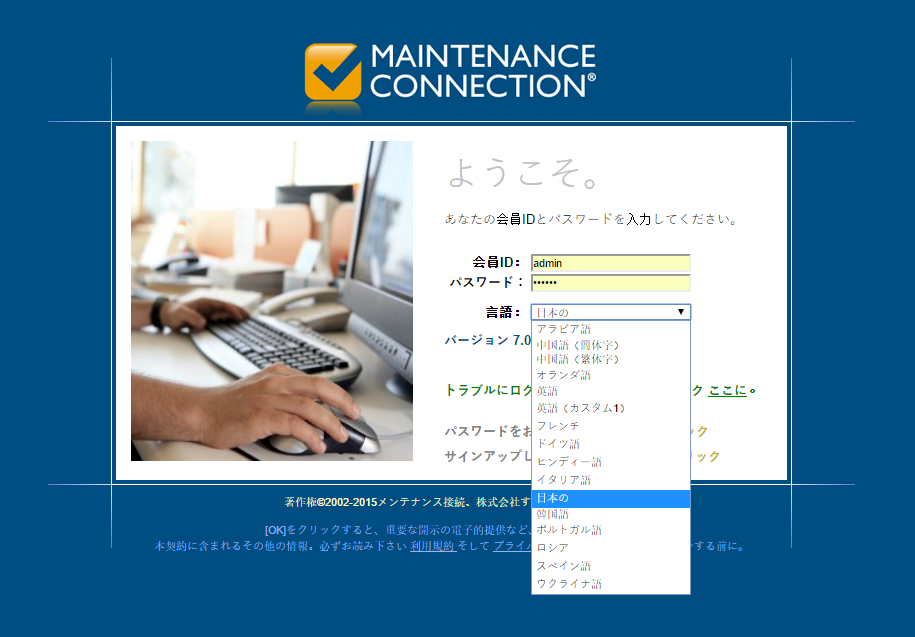
Now, to be fair, as we said, the vast majority we have seen do it exactly the same way, Accruent's MC is just doing what 'everyone' else does.
The obvious advantage is that you can quickly see what languages are supported. So if, for example, you are Japanese, and you want to see whether French is supported – because some of your employees are French, you can easily see in this list whether French is one of the supported languages if the list is in your (Japanese) language.
The problem we see with this is that if you don't speak the language that is currently selected … how do you select your language?
Now, some people will argue 'it's OK because if you start over, the page will always be back in English, and of course everyone can read English'.
Or as one person said 'Realistically, if you can't speak English, you can't use computers so as long as the default list of languages is in English, you are OK.'
We take a different tack. We figure it is far more important for you to be able to find YOUR language by having it written in your language than it is to see whether your staff that speak Hindi can use the product in their language. So, our language 'picker' has each of the languages in their own language.
Our copyright notices are in English
There is a simple legal reason for this. Any translations would or could render the copyrights invalid. So for legal reasons, yes, they are in English.
Our product names are generally in English
There are two reasons for this, first, legal – it is very time consuming and expensive to apply for trademark etc.., in multiple languages – so we would have to increase the price we charge for the products. And second, many of the product names don't really have a translation, many aren't real words, so trying to translate them would be a random activity. And yes we recognize that it would still make sense in languages that don't use the English character set to use the target set, but again, the cost of claiming trademark status would be too high to be worth it.
Our manuals and whitepapers are generally in English only
There is a high cost keeping manuals up to date. If we have a customer that is willing to pay to keep manuals up-to-date in a different language then we would be willing to do this, or if you want to, we can set your system up to show your translated documents instead of our English ones.
We don't control everything …
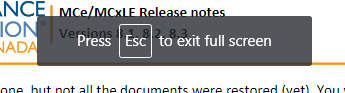
There are some things that are outside of our control. For example, in our native PDF viewer, when we switch you to full screen, some browsers show a message telling you how to return to regular screen.
The exact text (and whether there is text) depends on the browser and which language you have selected in your browser

Footnotes
-
1: I find it humorous that Americans seem to have a love for a British accent when it is spoken to them, but when they see it written down, they dismiss it as simply wrong. ↩
-
2: In general terms the approximately 64 Chinese languages are written using almost exactly the same script. There are 2 scripts in common use, the so called 'simplified' and the so called 'traditional'. The simplified officially is used throughout mainland China, the traditional is used throughout Taiwan and often used outside of China by persons of Chinese descent. ↩