
 Maintenance Connection Everywhere (MCe) · EAM/CMMS manuals
2022.05 Update:
We've been working with Heat/Thermal Cameras since 2009. The technology has improved, so we are updating our advice based on 2022 technology.
Overview
While MCe has supported Heat cameras since 2009, and even more strongly when we added pictures to tasks in version 6.8, thermal cameras got a lot more attention in 2020 due to COVID-19. But thermal cameras are valuable for so much more than just detecting sick people.
Heat cameras are very powerful tools for maintenance, preventative and predictive maintenance and should be in the tool sets of many of our customers.
We make NO MONEY whether you choose SEEK or FLIR or any other brand, we don't sell any of them and we don't make any referral fees from any of them – so we believe we have no biases other than to offer the best advice to our customers that we possibly can.
If you have experience and you disagree with our reasoning, or you have a use case that results in a different decision, please let us know so we can update this document and help more people.
What are they?
They capture the infrared radiation from objects. They let you see the temperature of the surface of the objects. They can see this heat even when there is no visible light – i.e. they can 'see heat in the dark' (the can also see heat in the light)
In the "electromagnetic spectrum" there are several arbitrarily named bands. They all travel at "the speed of light". Infrared is the section just "above" (bigger than) the visual section.
Thermal cameras take "light" from the infrared spectrum and map it into the visible light spectrum so humans can visualize the heat that our eyes cannot see. In a similar concept, AM and FM waves are 'mapped' (though not as directly) into sound we can hear, and TV maps into pictures and sound so you can 'see and hear' them.
The point is, when you look at a colorful Thermal image – you are looking at a 'artists rendition' of the Infrared – mapped into colors to make it easier for humans to understand. It would be just as possible (but a lot less useful) to map it into sound.
Side information for interest. You can safely skip this section if not interested.
As you go from the low end to the high end, the size of the waves get bigger.
At the low end from 0.0001nm (nanometers) to 0.01 nm we have the "Gamma Rays", these can be created from nuclear processes, and you don't want a lot of these passing through your body.
Next are x-rays in the 0.01nm to 10nm range. These also cause damage passing through your body but are 'safer' than gamma rays. These are 10 to 1000x's longer than the biggest gamma rays.
We then move up into the UltraViolet range, so called because they end where human sight begins – at the violet end. They range from 10nm to 380nm.
At around 380nm (depending on the person) we enter the visible light section. Noting that the word "visible" refers to nominal or normal human vision ranges. Some animals can see further up or down the scale than we can. Some birds, bees, butterflies, bats, rats and … reindeer can see in the ultraviolet range.

At around 740nm, we leave the visual and move into the "Infrared" again, so called because of its proximity to human perception of "red". Some snakes, butterflies, vampire bats, fish and mosquitos can see into the infrared range. Fascinating fact: Mantis shrimp have up to 16 cones instead of the 3 we human see, this gives them phenomenal sight compared to humans … and it seems to have no value to them, most of those light zones have no natural source and the mantis shrimp spends most of its life in a burrow where it couldn't see it even if it did exist.
In any event, the Infrared range is the range that interests us for Thermal cameras. From 740nm to around 1mm (There is no universally agreed definition on exactly what range is Infrared, but it starts generally where human sight leaves off.) Interesting side note: It is reported that more than half of the sun's energy that reaches the earth arrives in the Infrared spectrum. Probably not surprising given that the visual range is an incredibly tiny slice of the band compared to infrared.
Above that, you have other waves at different frequencies such as
- Radar around 1cm
- Microwave 1mm to 1m (Radar is in the Microwave range)
- FM around 1 m
- TV and shortwave fit in here
 AM around 100M
Why should I want a Thermal camera?
The simple answer is: For many jobs, a Thermal camera will provide better information faster, quicker repairs, better reporting to your customer or management, better decisions.
Heat or Cold is often an indicator of a problem.
- For example, on machinery, the hottest component often will be the broken one, or the one that is going to break soon.
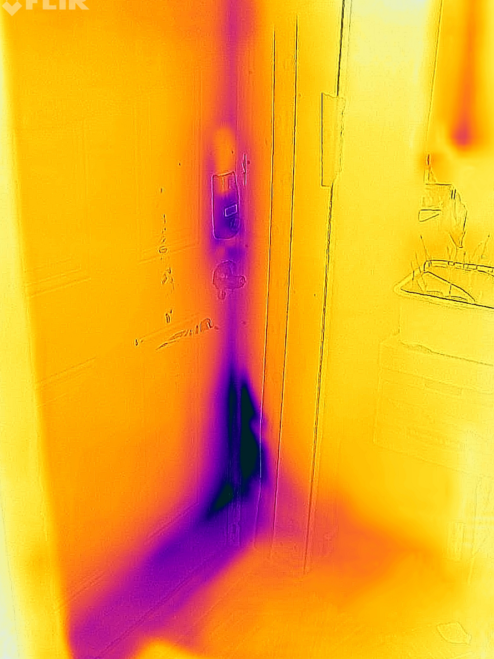
- In buildings in cold climates, in a picture taken inside, the coldest area shows you where you have thermal leaks (air flow, poor insulation) and can give you ideas of where 'the problem is' as well as where you can get the best value for improvement. Similarly pictures taken outside, it is the hottest areas that have the thermal leaks. Conversely, if you are cooling the building the reverse is the case – the point is though, you can find where you are gaining and losing heat.
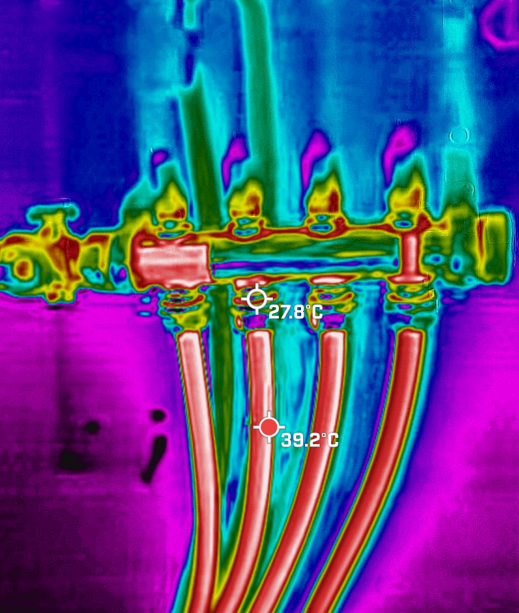
- With in-floor heating, you can find leaks by seeing where the heat 'puddles'.
- Other detection of heat or air-conditioning loss in HVOC systems
- Roof inspections
- Uniformity or lack of uniformity, for example a 3D printer plate should be fairly uniform in temperature, if not there is a problem.
Find things that are invisible. Noting that a thermal camera can NOT see through opaque objects, it can just see the heat that is coming from behind, through what is in the front. Indeed … it can't even see through most glass! (most glass blocks Infrared)
- If your building uses in-floor heating, you can trace the lines to see where they are very accurately, especially accurate on concrete floors. This then lets you know where you can safely put bolts or screws into the floor without causing leaks.
- My son, a firefighter, uses them for several purposes when fighting fires, from finding hot spots to finding a trapped firefighter or person or animal trapped in a burning building. Heat signatures travel through smoke, when visible light won't allow you to see.
If you provide, or would like to provide, inspection reports to your customers, images from Thermal cameras can provide the proverbial "picture is worth a thousand words." When combined with a custom, or even standard, stunning MCe report – you can convey to your customer, or boss, the information much more clearly than just a few words.
What won't work?
There are reports of using these cameras to locate vermin/wildlife, but most are unrealistic. In particular while heat signatures will travel through smoke haze and dust fairly well, it won't travel through a wall. So you aren't going to find a rodent nest, unless they are generating enough heat to be have the heat travel through the wall – the thermal cameras can't see THROUGH solid objects, they can only see the HEAT that has travelled through the solid object. So, it may help you, but you need to be realistic, especially with a thicker wall and smaller animals.
It can't see very well through water (which is interesting given how many fish can see in the infrared range), it will see the temperature of the surface of the water (so good for HVAC) not the objects in the water, so it won't locate a hot spot IN the water very well, except under circumstances where the water is calm and locally heated by what you are trying to locate or close to the surface, and even there it is going to be diffuse.
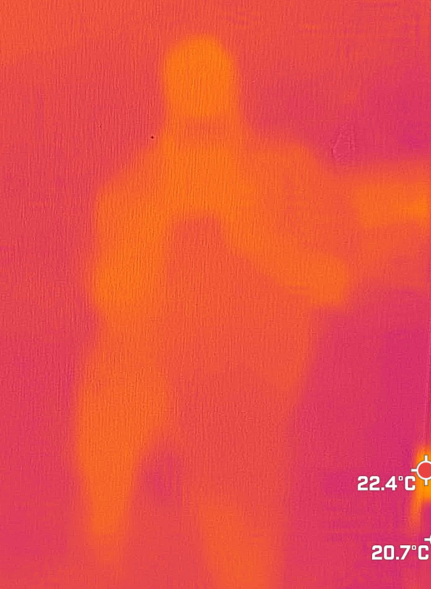
Most glass stops transmission of the infrared waves, so you can't take a thermal picture of something on the other side of most glass. (Noting that some vehicle windshields do let you.) As a result, the lenses that focus the infrared "light" use materials like zinc selenide, Germanium and Chalcogenide instead of the more common silica glass.
You also have to be careful with reflective surfacesas they will return reflected heat signatures. You can see this by taking a picture while facing a mirror, or even just a shiny wall paint, you will be able to see your thermal image reflect off the surface. The picture to the right was taken facing a glossy surface. The heat image is the photographer facing the wall, not the heat from the wall. Tip, take a picture at an angle if there are no other heat sources that may be reflecting.
Why is the resolution so low compared to visual light cameras?
The wavelengths of the infrared light are much longer (bigger), as a result the sensor components are much larger at any given level of technology. This means that with the same sized sensor, the image resolution is much lower.
The good news is … you don't usually need to have the same resolution for the purposes that you are using the thermal camera for. You need enough for your purpose. Yes, if your purpose is 'artistic' you might want a lot more resolution, but in the CMMS/EAS world, we are trying to spot and fix problems, and it turns out you almost never need extremely high resolution to do this. If you are working with tiny electronics, OK, that may require the higher resolution cameras. Or if you are taking images of objects a long distance away (anything more than perhaps 10 meters/30 feet away), but even there, it depends on what resolution you need – if you are trying to find a fire in a forest, you probably don't care, when you are mile away, about isolating it to 3 meters/10' resolution, but when you get on the ground, when you are physically closer, you may care to isolate down to a few cm/inches. But if you do care about hot spots that are cm/inches in size while flying overhead – then you will need the higher priced equipment and software that will point out those hot spots to you.
Tip: Use the panoramic feature of your Thermal camera to get a higher resolution image.
If you need it … then you have to buy the more expensive, and by more expensive we mean literally up to more than 100x's the cost ($50,000 vs $300) then it is available, but for most use, something that gives you
This is also why we like the FLIR, because of their ability to overlay a visual image, to make it easier to 'read' the thermal image.
Who wouldn't want a thermal camera?
Ignoring the "I want one because it lets me create really cool pictures" …
If all you do is meter readings, and not checking for problems with meters shorting out, then you don't need one.
If you do carpentry – you probably don't need one.
If you do standard plumbing repairs – you probably don't need one.
If all you do is customer support over a phone – you probably don't need one.
Basically, if 'heat' or 'cold' has no factor in your repairs or fault detection, then you probably don't need a thermal camera.
We estimate that about 30% of our customers, and of the remaining 70% that corporately need one or more, 80% of their technicians don't need one or can share one. It doesn't matter whether we are correct in these estimates of course. Just pointing out that not everyone will get the benefit of a perhaps $500 device.
But these may be reasons that you didn't think about:
- You might want, as a carpenter, to check for thermal leaks or other heating/cooling efficiencies.
- If you do computer repair – you may find having the ability to check for hot spots something that will speed up your fault detection.
- You probably didn't think about using it to find leaks in in floor heating systems (or maybe you did) or to use it to find where you can safely drill into the floor; I've had had in-floor heating throughout my building for over 15 years, and I admit, it wasn't until we started testing Thermal cameras that I realized by accident, I pointed it at the floor while walking to do a different job, that I could use it for making sure I didn't drill into the lines embedded in the concrete.
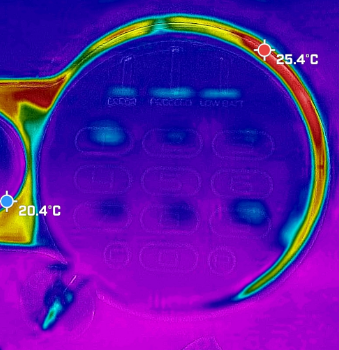
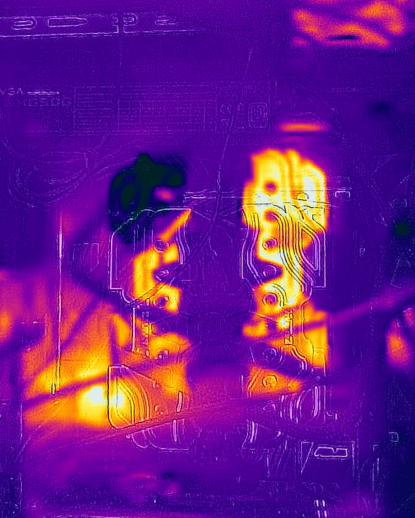
- Lock picking. So this is probably not a reason you buy – but something you should be aware of. With some sensitive enough equipment, tests have shown that you can read which buttons were pushed up to 30 minutes after you pressed them, from up to 60' away using a scope. In my case, the image on the right shows I hit the 123 and 789 buttons about 30 seconds before the image was taken. And you can even make a guess on the order based on how bright they are. If you worried about this, the best practice currently is: Place your palm over all the buttons after you unlock it.