Purpose
This document explains how to manually run a DataHub Connector to import data into the system and verify the imported records.
Prerequisites
Before running the connector, ensure the following requirements are met.
Ensure Connector is Active
You can use inactive connector only to run validation. But to import the data the Connector must be active.

Source File Availability
Prepare the source file containing the data to be imported.
The source file extension must match the reader configured in the connector Summary tab.
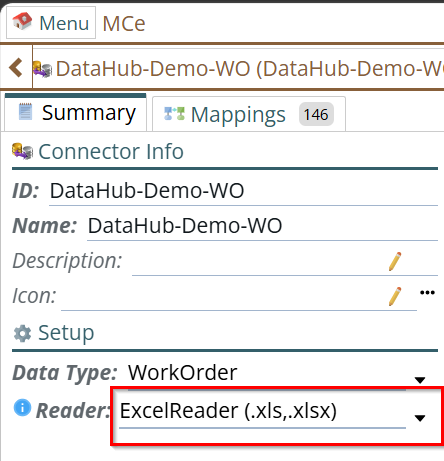
Supported readers include:
| Reader Type | Supported File Extension |
|---|---|
| Excel Reader | .xls, .xlsx |
| CSV Reader | .csv |
| JSON Reader | .json |
The uploaded file format must match the configured reader type. Unsupported formats cannot be processed.
Verify Source Column Headers
Ensure that the column headers in the source file are on the 1st row and match the connector mapping configuration.
Navigate to:
Mappings Tab → Active Standard → Active Standard Mappings → Source Field
The source file headers must match the configured Source Field values.
If column names do not match:
- Data from unmatched columns will not be loaded
- Unrecognized columns will be ignored during processing
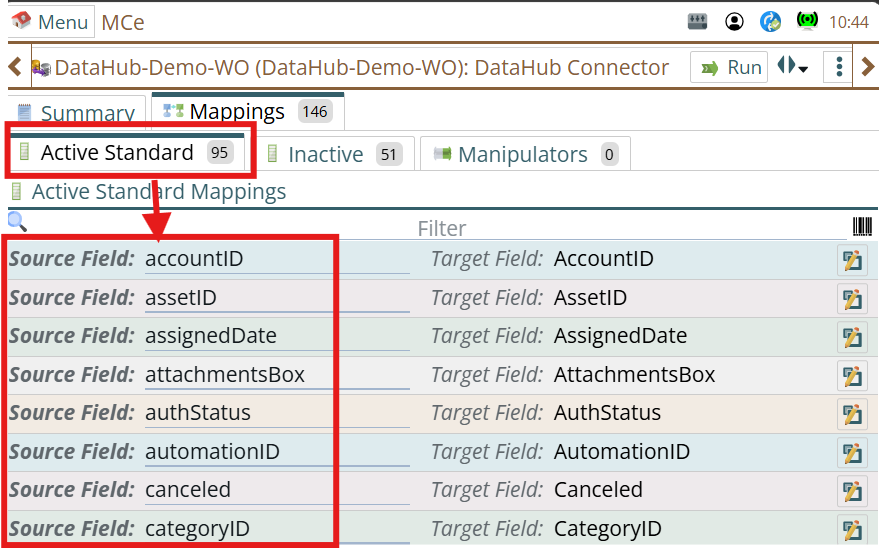
Important Note: The Source fields in the Inactive tab will be ignored even you have specified the column in the source file.
Verify Data Type Configuration
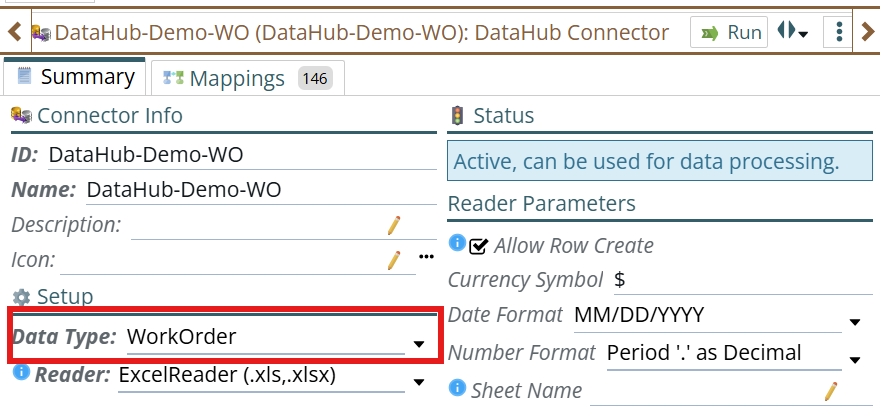
Open the connector Summary tab.
Confirm that the correct Data Type (Module/Table) is selected.
This determines where the imported data will be stored.
Examples may include:
- Asset
- Part
- WorkOrder
- Other configured modules
Incorrect Data Type configuration may result in importing data into an unintended location.
Running the Import
After all prerequisites are verified and the connector is active:
Step 1: Start the Import Process
- Open the connector.
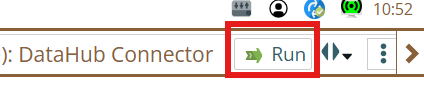
- Locate the Run button at the top-right corner.
- Click Run.
A new window will open.
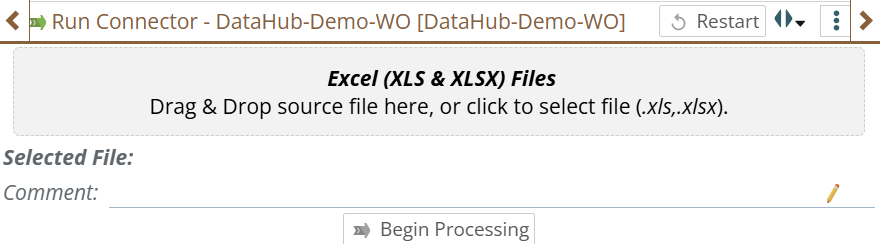
Step 2: Upload the Source File
Upload the import file by either:
- Dragging and dropping the file into the upload area
- Clicking the upload area and selecting the file manually
After successful upload:
- The uploaded file name will appear in the Selected File section
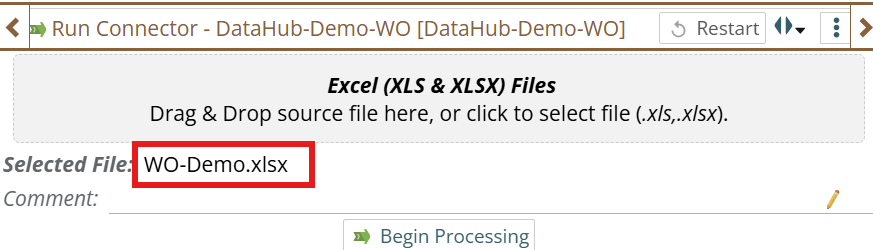
Step 3: Begin Validation
Click Begin Processing.
The connector will validate the source file before importing data.
Validation checks may include:
- Column mapping validation
- Required field checks
- Data structure validation
- Data existence check
- Data will be manipulated using manually defined or existing system's Converter/Validator/Mutator
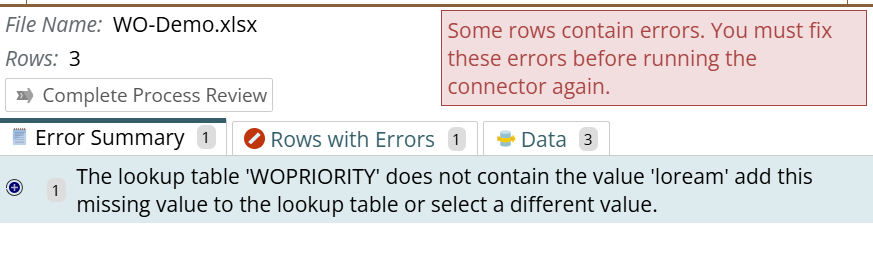
If validation errors are detected:
- Errors will be displayed
- Processing cannot continue until issues are corrected
Following screenshots are to show how it looks like when successful and failed validation
on Success Validation:
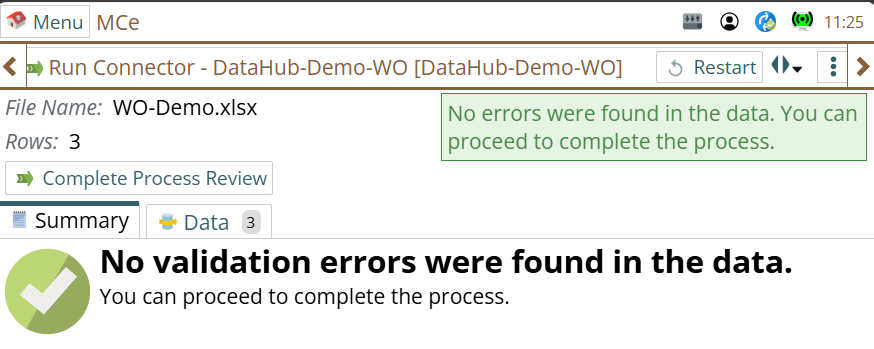
on Validation Failed:
Step 4: Review Loaded and Validated Data
After validation completes:
- Open the Data tab.
- Review the loaded records.
Verify:
- Expected rows are present
- Values are mapped correctly
- No unexpected blank fields exist
Step 5: Complete Import
If validation is successful:
Click Complete Process Review.
The import process will begin.
Possible outcomes are:
Import Failed
If errors occur during import:
- Error messages will be displayed
- Failed rows should be reviewed and corrected
Import Successful
If processing completes successfully:
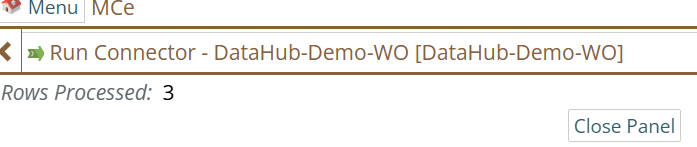
The system displays:
Successfully Imported <count> Rows
The imported records are now stored in the database.
Verify Imported Data
After import completes:
- Navigate to the module configured in the connector Data Type field.
- Verify that the imported records exist.
Check:
- Record count
- Field values
- Imported attributes
- Data relationships (if applicable)
Examples:
- Asset imports → Verify in Assets module
- Part imports → Verify in Parts module
- Work Order imports → Verify in Work Orders
Troubleshooting
Data Not Imported
Possible causes:
- Source file extension does not match configured Reader
- Source column names do not match mapping fields
- Required fields are missing
- Validation errors exist
- Import errors during processing
Additional Notes
- Connector must be Active before import execution.
- Validation occurs before database updates.
- Always verify mappings before uploading large files.
- Imported records should be validated after every import run.